Before calling an adviser or visiting a sales office, buyers of a new home go to the development’s page on the developer’s website. What can they see there of the home they will buy off-plan? To answer with figures rather than impressions, Khorama recorded on 24 November 2026 what 100 pages of new-build developments published by 35 developers in France actually show.
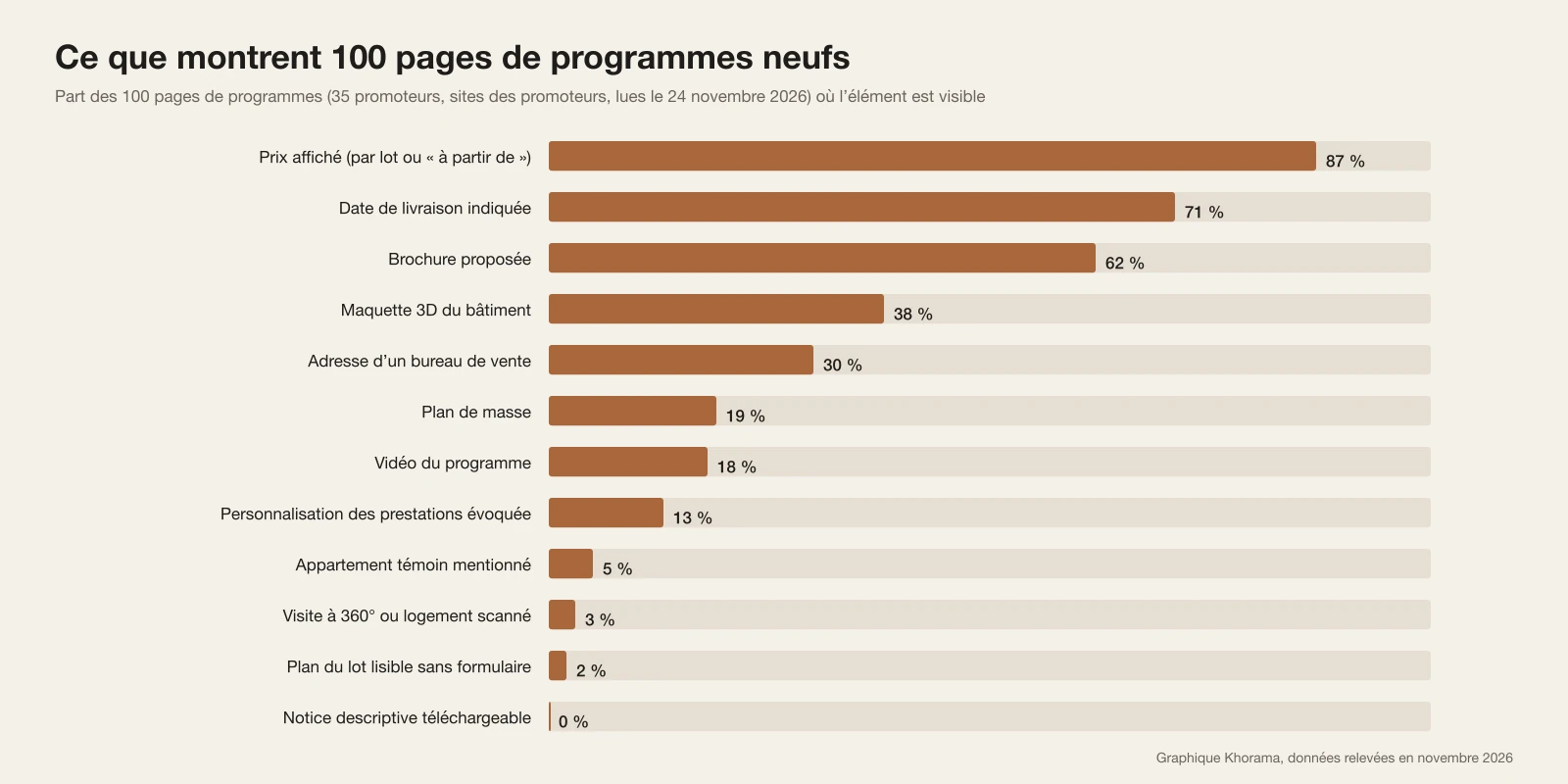
Three findings stand out. The price is almost always there (87% of pages). The unit’s floor plan is directly readable on only 2% of pages. And 3D, where it exists, mostly shows the building: 38% of pages have a 3D model of the residence, 3% a 360° tour or a scanned home.
Results are aggregated: no developer is named or ranked. The method, the sampling rule and the limitations are set out below.
What the pages show, in one table
Each row gives the share of pages where the element is visible on the development’s public page. What was not seen is counted as absent, never assumed.
| Element visible on the page | All (100 pages) | Large national developers (50) | Regional developers (50) |
|---|---|---|---|
| Price shown (per unit or “from”) | 87% | 96% | 78% |
| of which unit-by-unit prices | 68% | 78% | 58% |
| Completion date | 71% | 82% | 60% |
| Brochure offered | 62% | 70% | 54% |
| 3D model of the building | 38% | 62% | 14% |
| Address of a sales office | 30% | 54% | 6% |
| Site plan | 19% | 24% | 14% |
| Development video | 18% | 22% | 14% |
| Customisation of finishes mentioned | 13% | 14% | 12% |
| Show apartment mentioned | 5% | 10% | 0% |
| 360° tour or scanned home | 3% | 2% | 4% |
| Unit floor plan readable without a form | 2% | 0% | 4% |
| Downloadable specification document | 0% | 0% | 0% |
| Neither virtual tour nor video | 53% | 34% | 72% |
Price and date: almost always there
Price is the best-served information. 87% of pages show a price: 68% give a unit-by-unit list (at least three different prices), 19% a single “from” price. Of the remaining 13%, two pages say “price on request” and the others show none. The gap between the two groups of developers is clear: 96% of large national developers’ pages show a price, against 78% for regional developers.
The completion date appears on 71% of pages (82% for national developers, 60% for regional ones). A brochure is offered on 62% of pages: as a direct link on 22%, behind a button or a form on 40%. The site plan, which places the building on its plot and gives its orientation, appears on only 19% of pages.
The unit’s floor plan: rarely freely available
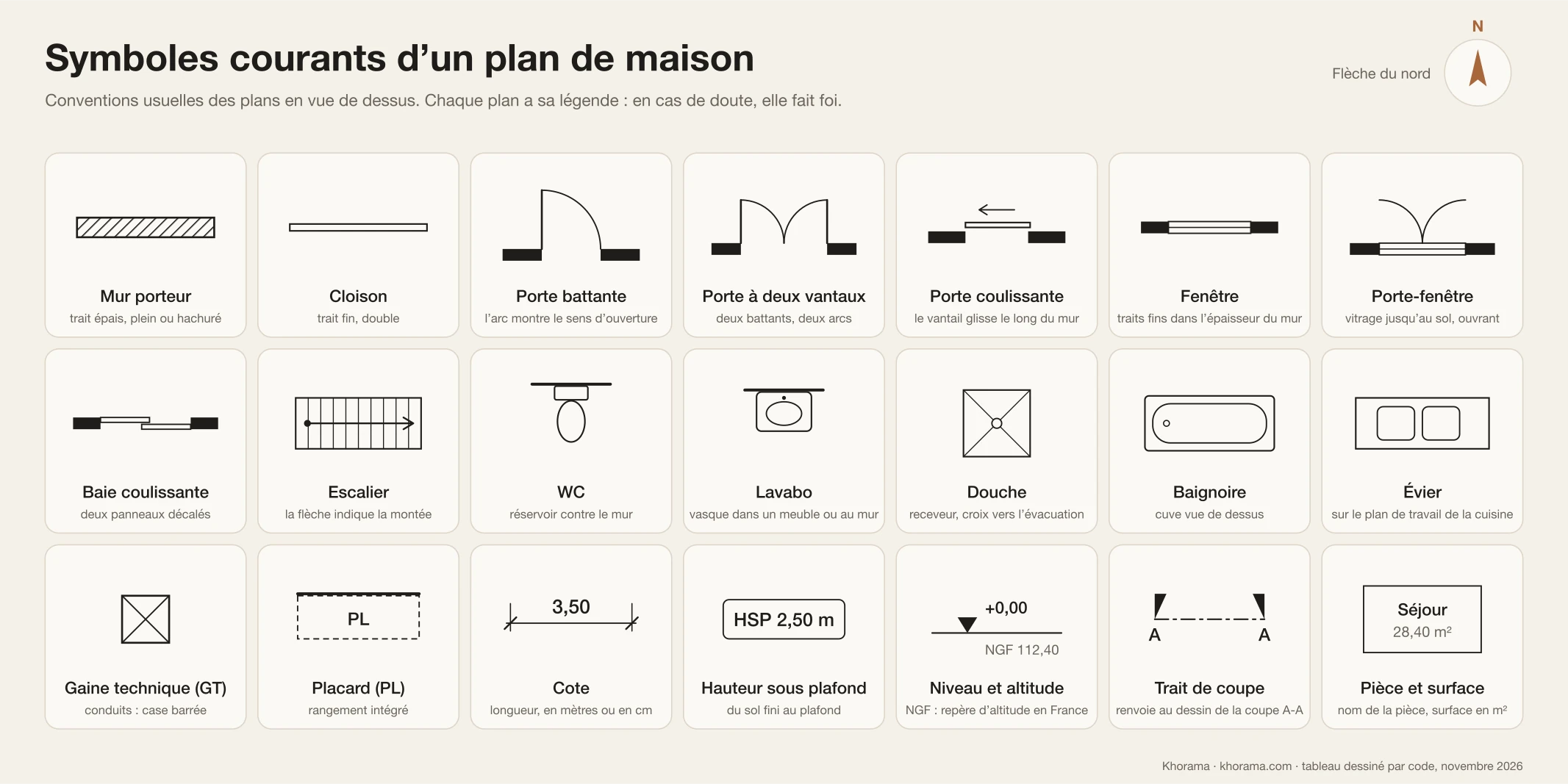
Yet the dimensioned floor plan is the document that lets buyers picture themselves in the home: the size of each room, where the bed goes, which way the doors open. It is also what developers protect most. Out of 100 pages, the plan file is present in the page only twice. 14% of pages explicitly offer it in exchange for contact details (“receive the plan”, “to view this plan and be contacted”). 22% show a “view the plan” button whose effect could not be checked without running the page. 62% show no unit plan.
Large national developers almost always offer the plan (56% of their pages, via a form or a button) but never as a direct read. Regional developers most often leave it out of the page (80%).
| Access to the unit’s floor plan | All | National | Regional |
|---|---|---|---|
| Plan file readable in the page | 2% | 0% | 4% |
| Plan offered for contact details | 14% | 20% | 8% |
| “Plan” button, access not verifiable | 22% | 36% | 8% |
| No unit plan seen | 62% | 44% | 80% |
3D: mostly the building, rarely the home
41% of pages offer some form of virtual tour. In almost every case it is a 3D model of the building (38% of pages): the residence seen from outside, which you rotate to spot a unit on a façade. It is common among large national developers (62% of their pages) and rare among regional ones (14%).
Seeing inside is much rarer: 3 pages out of 100 offer a 360° tour or a scanned home. No page showed a view from a unit’s floor or balcony. A development video appears on 18% of pages, and 53% of pages have neither a virtual tour nor a video (34% for national developers, 72% for regional ones).
Sales office, show apartment, specification: what the page leaves out
30% of pages give the address or opening hours of a sales office (54% for national developers, 6% for regional ones); a further 19% only mention “sales offices”, usually in a legal notice. A show apartment is mentioned on only 5% of pages.
The specification document, which sets out the promised materials and fittings and serves as the reference at handover, cannot be downloaded from any page; it is merely mentioned on 4%. Finally, 13% of pages mention the customisation of finishes (choice of finishes, options catalogue).
By region
Regions with at least 10 pages in the sample are shown separately; the nine other regions are grouped (Bourgogne-Franche-Comté, Brittany, Centre-Val de Loire, Grand Est, Hauts-de-France, Normandy, Nouvelle-Aquitaine, Pays de la Loire, Provence-Alpes-Côte d’Azur). Regional counts are small: these gaps are indications, not precise measurements.
| Region of the development | Pages | Price shown | Completion date | Virtual tour | Unit plan offered | Neither tour nor video |
|---|---|---|---|---|---|---|
| Île-de-France | 30 | 93% | 73% | 53% | 50% | 43% |
| Occitanie | 14 | 79% | 86% | 43% | 21% | 57% |
| Auvergne-Rhône-Alpes | 12 | 92% | 75% | 58% | 42% | 33% |
| Other regions (9) | 44 | 84% | 64% | 27% | 34% | 64% |
Method
Sample. 100 pages of new residential developments on sale, on the developers’ own websites (no listing portals): 50 pages from 10 large national developers (5 pages each) and 50 pages from 25 regional or independent developers (2 pages each). The latter were found through a web search per region on 24 November 2026, then kept if they develop housing and publish their own list of developments; large national groups are excluded from this group.
Sampling rule. For each developer, the addresses of development pages published in its sitemap, or failing that linked from its home page, are sorted then shuffled with a fixed seed specific to the developer; pages are read in that order until 5 or 2 valid ones are kept. A page is valid if it responds, if robots.txt allows it, and if it is indeed the page of a residential development (no offices, shops, or managed residences for students, seniors or tourism) still on sale. 143 pages were read to keep 100: 31 set aside as non-residential or managed residences, 4 redirected to a listing page, 4 with no sign of sale, 2 sold and 2 pages of completed projects.
Grid. For each page: price (per unit, “from”, not seen), completion date, brochure, unit floor plan (readable file, for contact details, unverifiable button, not seen), site plan, virtual tour and its type (3D model of the building, 360° panorama, filmed or scanned home, view per floor), video, sales office and show apartment, specification document, customisation of finishes. Reading rules are written once and applied identically to every page; the header, the footer and any wording repeated on the site’s home page are set aside, so that only what belongs to the development is counted. Borderline cases were checked by hand.
Collection rules. Public pages only, read once, at most one page every three seconds; robots.txt respected (a site that refuses AI crawlers was excluded); no form filled in, no account created, nobody contacted. All counts are made by a script; the raw data stays offline and is not published.
Exclusions. Among the large national developers considered, one was set aside because its list of developments cannot be read without running the page, one because its robots.txt refuses AI crawlers, and one because its site did not respond; they were replaced by the next ones on the list. One regional developer was set aside because none of the first 25 pages drawn passed the filter.
Limitations
Pages were read as the server sends them, without running JavaScript or clicking. An element loaded afterwards (gallery, tab, pop-up) may therefore have been missed: the percentages are minimums of what a visitor sees. That is why the number of renderings is not published: counting it reliably would require opening every gallery.
The sample gives the same weight to every developer within a group, whatever its output; it does not represent all new homes on sale. Regional counts are small. The survey describes a single day: a development page changes over the course of sales.
What this changes for a developer
On most pages, buyers learn the price and the date before they learn about the home. A few simple steps close that gap without changing websites:
- Show each unit’s floor plan openly, at least as an image, and keep the form for the full file (dimensioned plan, specification, price list). A visible plan qualifies the contact instead of preceding it.
- Publish the site plan and the orientation: 19% of pages do, although orientation is one of the first questions asked in the sales office.
- Show the inside, not just the façade: a model of the building locates the unit, an interior tour lets buyers live in it. Only 3 pages out of 100 allow this today.
- Make the specification document downloadable for units on sale: no page does, yet it is the document buyers will reread at handover.
The third point is what Khorama addresses: from each unit’s dimensioned floor plan, the software produces a 360° tour of the home, true to the dimensions, which buyers open with a simple link.