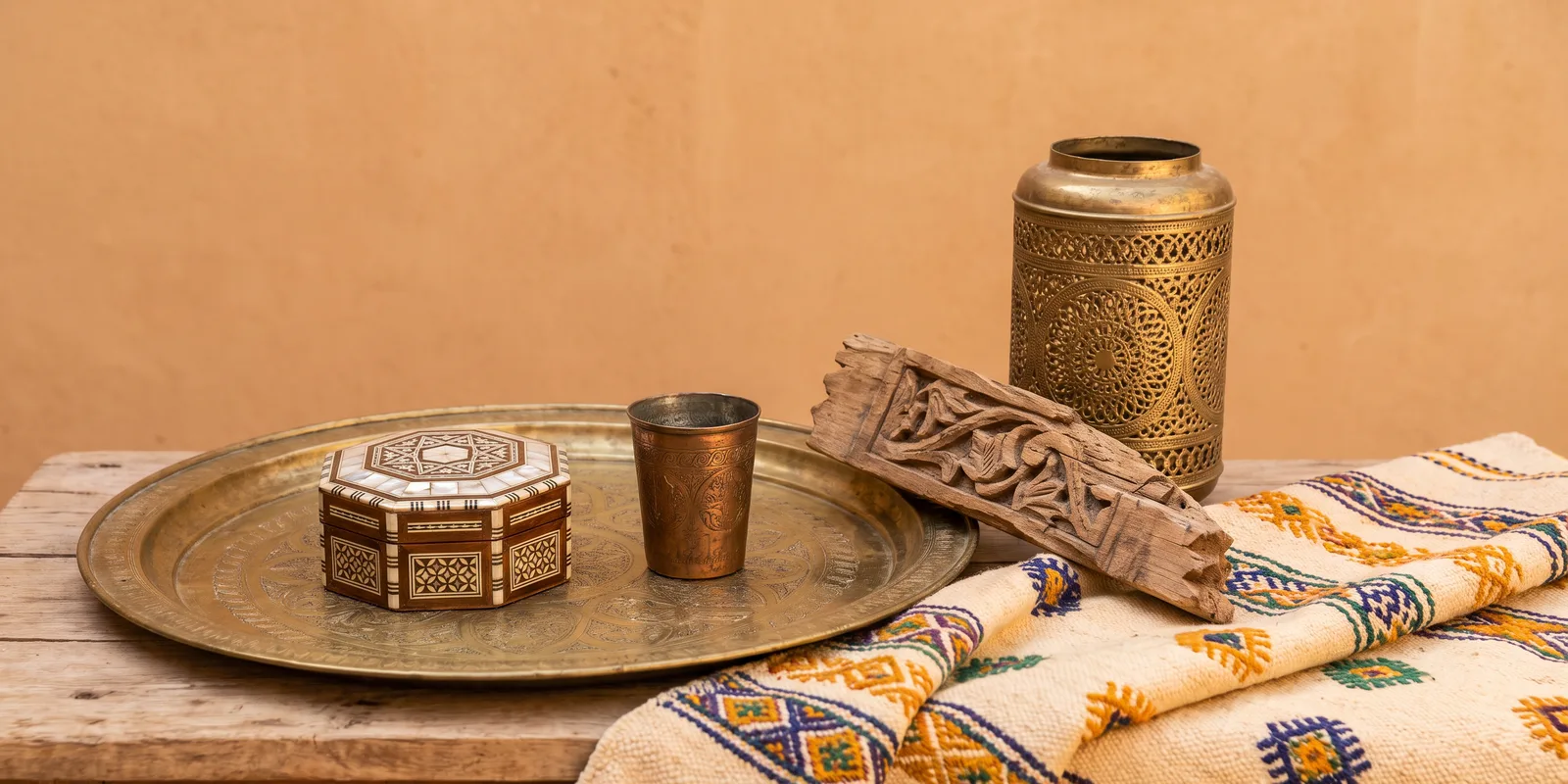
Oriental style, as offered by Khorama, brings together the decorative arts of Morocco and the Arab world: carved woods, worked metals, embroidered textiles. It is a style of hospitality, designed for receiving guests. This page traces its origins and explains which buyers it speaks to, particularly in the Gulf and North African markets.
Origins and history
The decorative arts of Morocco and the Arab world rest on ancient crafts: carving and painting cedar, mother-of-pearl inlay, chasing brass and copper, weaving and embroidery. The Metropolitan Museum of Art, for example, holds a carved and painted fourteenth-century cedar panel from the Marinid period, and in 2011 had a Moroccan court built by craftsmen from Fez.
In the twentieth century, architects and decorators reinterpreted these traditions in contemporary houses: patios, low banquettes along the walls, filtered light, local materials. In the Khorama tour, the style comes through furniture and textiles; it adds no arch, mashrabiya or zellige the home will not have.
Materials, colours and furniture
| Feature | What defines it |
|---|---|
| Materials | Carved cedar and walnut, inlaid mother-of-pearl, pierced and hammered brass, engraved copper, embroidered and woven textiles. |
| Colours | Saffron, indigo, emerald, terracotta, on ivory and ochre sand. |
| Typical furniture | Long low banquettes along the walls with bolsters and woven cushions, hammered-brass tray table on a cedar stand, small mother-of-pearl inlaid table, leather poufs. |
| Accessories | Tea set, pierced lanterns, woven rugs; rich but never piled up. |
The big names of the style
Hassan Fathy. The Egyptian architect designed from 1945 the village of New Gourna, opposite Luxor, in mud brick, with inner courtyards, domes and vaults; the project, left unfinished, became a reference for architecture based on local materials and crafts.
Bill Willis. The American decorator based in Marrakesh helped bring Moroccan crafts such as tadelakt, monumental fireplaces and zellige back into favour, notably in the houses of Yves Saint Laurent and Pierre Bergé.
Public facts, checked against the sources listed at the end of the page. These designers have no connection with Khorama and do not endorse this software.
Which buyers is it for?
Oriental is a culturally situated style: it speaks very strongly to buyers who recognise themselves in it, and may seem less natural elsewhere. It is the obvious welcoming style in the Gulf and North African markets, and a relevant second style elsewhere.
To see what the buyer receives, take the 360° tour of demo unit B204, produced in four other styles.
- Buyers from the Gulf and North Africa (Saudi Arabia, the Emirates, Qatar, Oman, Morocco, Tunisia, Egypt): a reception room furnished in local codes helps them picture themselves.
- Families who often entertain: low banquettes and a large living room show the home’s capacity to receive.
- Expatriate or diaspora buyers buying remotely: the 360° tour lets them see the home in a familiar setting without travelling.
- Large homes and villas: the richness of the materials needs space to stay legible.