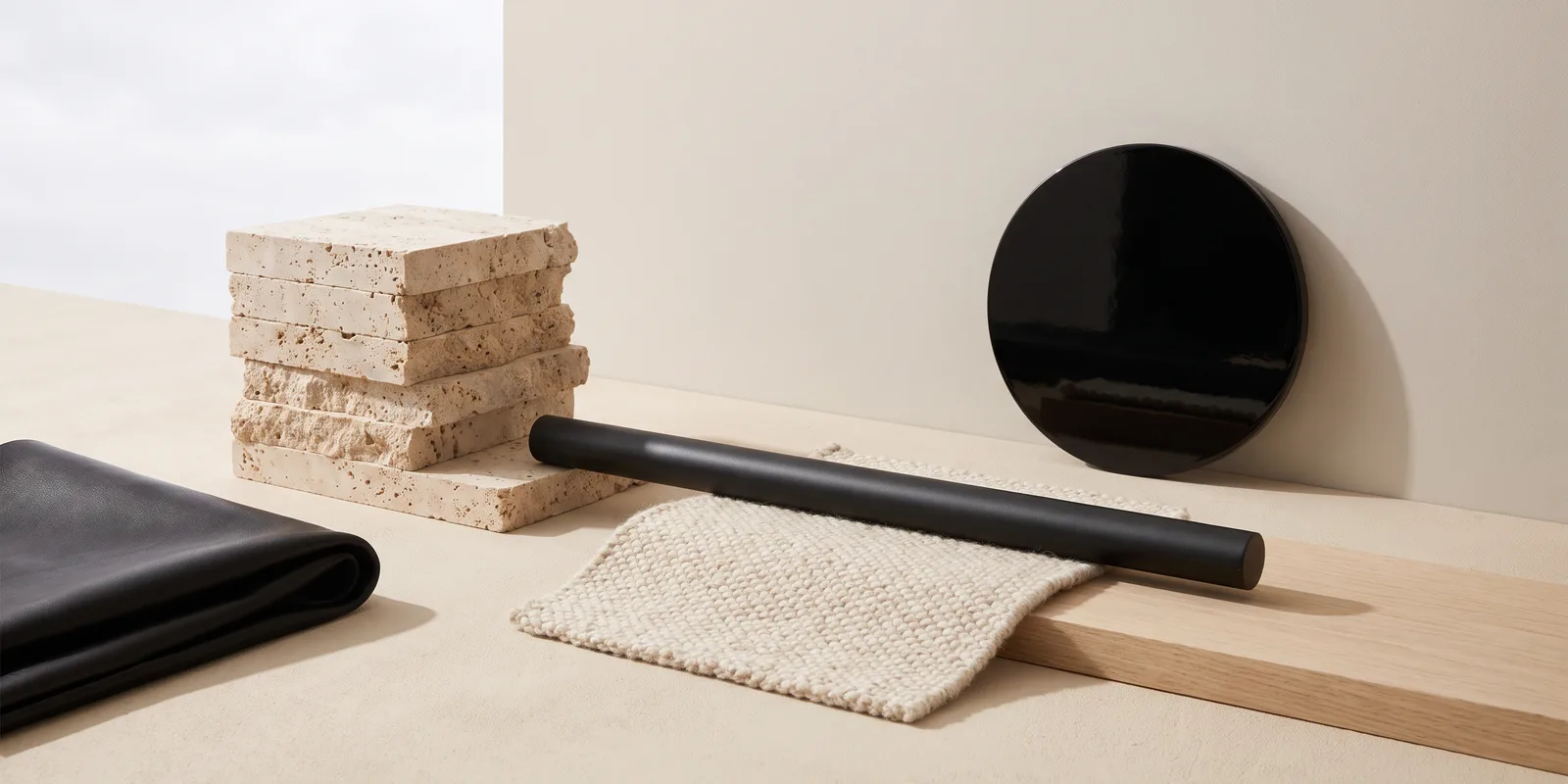
Modern style, often also called “contemporary”, is the style of today’s interiors: calm, practical, free of decorative clutter, with a few graphic pieces. This page goes back to its roots, the modern movement of the 1920s, and explains which buyers it speaks to.
Origins and history
In the late 1920s, European architects and designers brought industrial materials into the home: tubular steel, glass, stretched leather. They rejected ornament and designed furniture conceived for the body and for use.
Today’s modern style keeps this legacy (clean lines, honest materials, few objects) while softening it: rounded corners, woven wools, stone and pale wood temper the rigour of the early days.
Materials, colours and furniture
| Feature | What defines it |
|---|---|
| Materials | Pale oak, matt metal, smooth leather, plain woven wool, travertine, lacquer. |
| Colours | Warm white, charcoal, sand; a few graphic blacks. |
| Typical furniture | Low, deep sofa with a rounded silhouette, black leather armchair on a tubular steel frame, coffee table of travertine blocks, arc floor lamp. |
| Accessories | Few and graphic: a large abstract artwork, a sculptural vase. |
The big names of the style
Eileen Gray. The Irish designer and architect based in France built the E-1027 villa at Roquebrune-Cap-Martin from 1926 to 1929 and designed the Bibendum armchair in 1926, made of padded rolls on a tubular steel frame.
Le Corbusier, Pierre Jeanneret and Charlotte Perriand. Together, the three designers signed in 1928 the adjustable chaise longue (LC4), in tubular steel, which became one of the emblematic pieces of the modern movement; Pierre Jeanneret, Le Corbusier’s cousin, is one of its less often cited authors.
Public facts, checked against the sources listed at the end of the page. These designers have no connection with Khorama and do not endorse this software.
Which buyers is it for?
Modern is a current and legible style: it shows a home of today, with no reference to the past, which suits the image of a new development well.
To see what the buyer receives, take the 360° tour of demo unit B204, produced in four other styles.
- Urban professionals and young couples: the style matches the interiors they like and see in magazines.
- International buyers: free of local references, it is understood everywhere.
- Developments with contemporary architecture: the furnishing extends the façade and the large windows.
- Investors: it gives a current image of the property without overloading it.